- Commercial Greenhouse
- Film Greenhouse
- PC Greenhouse
- Glass Greenhouse
- Tunnel Greenhouse
- Scientific Research Greenhouse
- Vegetable Greenhouse
- Flower Greenhouse
- Multi-span Greenhouse
- Sawtooth Greenhouse
- Greenhouse Equipments
- Greenhouse Accessories
- Hot Dip Galvanized Pipe
- Irrigation System
- Hydroponics System
- Planting Tools
- Planting technology
Tel: +86 191 5068 3942
Fax:
Mobile: +86 191 5068 3942
Contact: Alina
E-mail: sales@cngreenhouses.com
SKYPE:


Reinforced Film Greenhouse Cover - Choose by Climate Zone
Reinforced film greenhouse cover for windy, snowy, high-UV or humid sites: clear film at 0.15/0.12 mm, hot dip galvanized frame and aluminum clips.
.
TEL:+86 191 5068 3942
- Features


Two houses of the same model, covered with the same film on the same day, do not hold that cover equally. One keeps its sheet intact season after season; the other loses a panel every spring, always on the same corner. The difference is rarely the film and rarely the frame. It is the site: how hard the wind hits, how long snow sits on the roof, how strong the sun is and how wet the air stays. This page is about matching film and fixing to a particular place.
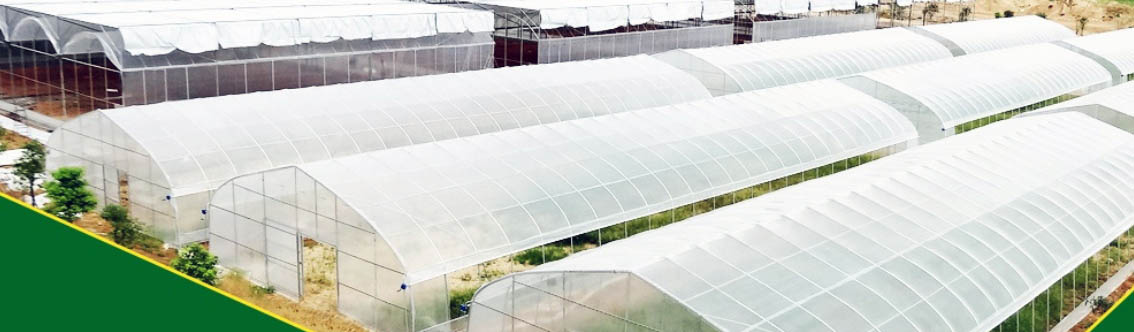
The house itself does not change. The frame is hot dip galvanized steel pipe under an arch roof, with spans of 6.4, 8, 9.6 or 10 metres and a total height of 4.3 to 6.5 metres, and it may only be covered by polyethylene held with aluminum clips. The covering is standard clear greenhouse film at 6 mil, at 0.15 mm or 0.12 mm, single layer or double, and the structure is drawn for a design wind load of 0.35 kN/m2. The model is listed as suitable for all climate conditions; a climate changes the mix inside that description.
This page stays on that decision; thickness grades, the chemistry of ultraviolet ageing, and how a cover is measured and tensioned each have a page of their own.

Four Site Conditions That Decide the Cover Specification
Four site conditions decide the specification, each pushing it a different way. Wind loads the sheet across its whole face and works on every fixing at once, so it is answered with the heavier film, closer clip spacing and frame bracing. Snow loads the roof from above and stays, so it is answered by roof shape, the length of the unsupported span and a clearing routine. Ultraviolet intensity ages the sheet rather than loading it, so it is answered by keeping a protected film in the specification and renewing it before the film goes yellow. Humidity works on the metal and the film face rather than on the structure's strength, so it is answered by coating quality, air movement and what the sheet carries on its face.
Two of the four can be measured before an order is placed: the coldest temperature the site is expected to reach, and the average wind speed at the site.


Windy Sites: Heavier Film, Tighter Clip Spacing, More Bracing
The film is held only by aluminum clips set into the frame channel, so on an exposed site the first decision is the film: of the two covering thicknesses this model is listed with, 0.15 mm and 0.12 mm, an exposed site is the case for the heavier one, since a thicker sheet resists flapping and carries a tear more slowly. The second is the fixing pattern, the same clips set closer along the channel, so no run of unsupported sheet is long enough to lift and slap in a gust. The third is the frame, described by the design wind load of 0.35 kN/m2, a pressure on the exposed surface rather than a wind speed, and it is the number to quote for an exposed site.
Two habits go with the hardware. Check the clips after a storm as well as the film, since a clip that has lost its grip starts the next failure. And choose the position before the house is placed, since a house sheltered by a hedge or building on the prevailing wind side has a longer cover life. Where a standing house is being reinforced instead, the points worth working through are in our note on greenhouse wind reinforcement points.
Snow-Load Sites: Roof Shape, Span Length and Clearing
Snow arrives slowly and then stays, which makes it different in kind from wind. The arch roof is the first defence, because a curved roof lets snow slide towards the eaves instead of holding it in a pocket; the second is roof span, since with a choice of 6.4, 8, 9.6 and 10 metres a narrower span keeps the unsupported run of roof shorter, which is the practical lever where a deep snow pack is normal.

What a specification cannot do is shovel. Snow that has crusted will not clear itself off an arch, so the routine is the one that protects any roof: clear it before it consolidates, work from the sides rather than under the ridge, and never let a drift stand against the low end wall where the film turns into the channel. Cold is the other half of a snow climate, and the covering is intended to prevent heat loss and cold air intrusion, so insulation is held without extra energy being spent on it. Background on winter performance is in our note on winter resistance and heat preservation in greenhouses.
High-Ultraviolet Sites: Keeping the Protection in the Specification
Where the sun is strong the sheet is the part of the house that ages first, so the question is which sheet to accept. This model is listed with standard clear greenhouse film at 6 mil, at 0.15 mm or 0.12 mm, and that clear film is a protected product rather than plain polyethylene; a high ultraviolet site is not the place to substitute an unprotected film, because the property being relied on is exactly the one the sun removes first.
Two decisions follow. Treat the covering as a part with a working life rather than a permanent fitting and renew it on a planned cycle, since a sunlit site reaches that point earlier and a renewal booked between crops costs far less than one forced by a mid-season split. Then take light load off the film where practical, which in this range means a shading system added to the structure on request rather than a change of film. One caution belongs with it: buyers sometimes ask for the film to be simplified for a hot, bright site, and that is the one change not to make.
Hot, Humid Sites: Fixings, Air Movement and the Film Face
A humid site is the least dramatic of the four and the costliest over a decade, because it works on metal and the film face rather than on their strength. The two parts that answer it are the galvanized frame and the aluminum clips: hot dip galvanized pipe keeps the structure free of rust in damp air, and aluminum clips hold the film at the channel without corroding onto it as a plain steel fitting would. On a coastal or permanently damp site it is worth naming the condition when ordering, and the pipe and coating are described under the hot dip galvanized pipe frame we supply.
The second lever is air movement, a design decision rather than a repair. Ventilation here is manual or electric, so the vent area and the drive are worth settling while they can still be built into the structure, and air movement is also what keeps the inner face of a clear film from staying wet long enough to grow a green surface film. The vents, clips and other fittings are grouped under greenhouse accessories and fixings.
Build Data and Add-On Systems, Whichever Zone Applies
Whichever condition a site leads on, the house is the same. The frame is hot dip galvanized steel pipe with spans of 6.4, 8, 9.6 and 10 metres and a total height of 4.3 to 6.5 metres under an arch roof; the covering is standard clear greenhouse film at 6 mil, at 0.15 mm or 0.12 mm, single or double layer, held with aluminum clips; ventilation is manual or electric; the covering is intended to prevent heat loss and cold air intrusion; and the structure is drawn for a design wind load of 0.35 kN/m2. Crops are vegetables, fruit, flowers and seed nursery stock, and sizes are quoted to the customer's own drawing rather than a fixed footprint. The pipe is specified at 70 to 85 micrometres of zinc under BS EN ISO 1461 and assessed to BS EN ISO 14713-1, so the frame's working life follows the corrosivity class of the site: class C2 (clean), C3 (urban), C4 (industrial) or C5 (coastal).
The systems added on request are the part that can be tuned to a climate: cooling and heating, irrigation, ventilation, fertilisation, shading and benches. Read against the four conditions the pairing is direct: cooling and shade for a hot site, heating for a cold one, air movement for a humid one, and for a windy site the frame and fixings rather than equipment. These belong in the same conversation as the covering decision, and settling them together stops a house being ordered for one climate and equipped for another. The houses they are built into are shown under the polyethylene covered houses we supply.


Fixing a Specification With the Supplier
The company behind this house is a manufacturer rather than a trading house, and the greenhouse items it sells are produced in its own works, which allows quality control and competitive pricing on the same order. The structure has been manufactured for above 35 years in the company's own frame factory.
A quotation is built from the quantity of houses required and the crops they will carry, and for the decision on this page it is worth adding the local temperature range and the average wind speed at the site, since those two figures decide whether a site leads on wind, snow or ultraviolet conditions. Samples of the greenhouse products, including covering components, are free of charge, with sample freight borne by the customer. After the order, an after sales engineer provides layout drawings and the installation manual, and can travel to the customer's country where on site supervision is wanted. A house leaves the works in three groups, metal structures, covering system and install accessories, so the covering group is the part a climate will ask to be renewed. Trade reporting on covering and structure choice is published by HortiDaily, and public guidance on protected cultivation includes material from the USDA.
If you need help matching a cover specification to your own site, call us on +86 191 5068 3942 or send an e-mail to sales@cngreenhouses.com. Tell us the wind, snow, sun and humidity conditions the house will work in, and the combination on this page can be settled against your site rather than in the abstract.


Frequently Asked Questions
Q: Which covering thickness should be specified for a windy site?
The heavier of the two thicknesses this model is listed with, 0.15 mm rather than 0.12 mm, on the standard clear film at 6 mil, with the aluminum clips set closer along the channel so that no long run of film is left unsupported. The frame is designed for a wind load of 0.35 kN/m2, and quoting that figure when ordering turns an exposed site into a written specification.
The heavier of the two thicknesses this model is listed with, 0.15 mm rather than 0.12 mm, on the standard clear film at 6 mil, with the aluminum clips set closer along the channel so that no long run of film is left unsupported. The frame is designed for a wind load of 0.35 kN/m2, and quoting that figure when ordering turns an exposed site into a written specification.
Q: Does snow have to be cleared off a film greenhouse?
Yes, and waiting does not help. The arch roof lets snow slide towards the eaves, but a pack that has crusted will not clear itself, so clear it before it consolidates, work from the sides rather than under the ridge, and never let a drift stand against the low end wall. Where deep snow is normal, a shorter roof span keeps the unsupported run of roof shorter.
Yes, and waiting does not help. The arch roof lets snow slide towards the eaves, but a pack that has crusted will not clear itself, so clear it before it consolidates, work from the sides rather than under the ridge, and never let a drift stand against the low end wall. Where deep snow is normal, a shorter roof span keeps the unsupported run of roof shorter.
Q: What should be specified differently on a hot, humid site?
The fixings and the air movement rather than the film. Hot dip galvanized pipe keeps the structure free of rust in damp air, and aluminum clips hold the film at the channel without corroding onto it. Ventilation is manual or electric in this range, so the vent area and the drive are worth settling at the design stage rather than retrofitting later.
The fixings and the air movement rather than the film. Hot dip galvanized pipe keeps the structure free of rust in damp air, and aluminum clips hold the film at the channel without corroding onto it. Ventilation is manual or electric in this range, so the vent area and the drive are worth settling at the design stage rather than retrofitting later.
Q: What are the covering and frame figures for this house?
Cover: standard clear greenhouse film at 6 mil, at 0.15 mm or 0.12 mm, single layer or double, held with aluminum clips. Frame: hot dip galvanized steel pipe under an arch roof, spans of 6.4, 8, 9.6 or 10 metres, total height 4.3 to 6.5 metres, ventilation manual or electric, design wind load 0.35 kN/m2. Crops are vegetables, fruit, flowers and seed nursery stock.
Cover: standard clear greenhouse film at 6 mil, at 0.15 mm or 0.12 mm, single layer or double, held with aluminum clips. Frame: hot dip galvanized steel pipe under an arch roof, spans of 6.4, 8, 9.6 or 10 metres, total height 4.3 to 6.5 metres, ventilation manual or electric, design wind load 0.35 kN/m2. Crops are vegetables, fruit, flowers and seed nursery stock.
Q: How is a quotation prepared for a specific site?
From the quantity of houses required and the crops they will carry, and for a climate decision it helps to add the local temperature range and the average wind speed. Those two figures decide whether the specification leads on wind, snow or ultraviolet conditions.
From the quantity of houses required and the crops they will carry, and for a climate decision it helps to add the local temperature range and the average wind speed. Those two figures decide whether the specification leads on wind, snow or ultraviolet conditions.
Q: Are samples supplied, and who pays the freight?
Samples of the greenhouse products, including components of the plastic film houses, are supplied free of charge, with the freight on a sample delivery borne by the customer. For a covering order, the quotation is built from the quantity of houses and the crops grown in them.
Samples of the greenhouse products, including components of the plastic film houses, are supplied free of charge, with the freight on a sample delivery borne by the customer. For a covering order, the quotation is built from the quantity of houses and the crops grown in them.
Note: If you're interested in the product, please submit your requirements and contacts and then we will contact you in two days. We promise that all your informations won't be leaked to anyone.
 Deutsch
 Español
 Français
 Italiano
 Português
 日本の
 한국어
 العربية
 български
 hrvatski
 česky
 Dansk
 Nederlands
 suomi
 Ελληνικά
 हिन्दी
 norsk
 Polski
 Română
 русский
 Svenska